The countdown timers are back. Some site put one at the top of an article this week: days, hours, and minutes ticking down to August 31, 2026, the morning "Chrome kills your extensions." The all-caps version adds an exclamation point.
I'll save you the arithmetic. The extensions that August 31 supposedly kills stopped running last summer, and if you're reading this in a Chrome that works, none of yours are on the list. The dramatic part of this story already happened, quietly, more than a year ago. What's left is a database cleanup at the Chrome Web Store.
Two things, then. First, the boring reassurance, with exact dates, because a wrong date is the whole reason people are scared. Then the part worth your time: why Google spent four years dragging every extension developer through this migration, and whether the people who lost their favorite ad blocker have a real complaint. They partly do, and I'll say where.
The short answer is that you cannot re-enable a Manifest V2 extension in Chrome — there is no toggle, policy, flag or switch left, and this post explains exactly when each one was removed. What you can do is replace it. I've written up every route that still works in 2026: how to keep using unsupported Chrome extensions.
The dramatic part already happened
Manifest V2 is the format that described Chrome extensions for over a decade. It launched in 2012. Its replacement, Manifest V3, reached stable Chrome on January 19, 2021, and then Google spent years slowly closing every door that let the old format keep running. The timeline matters, because each step removed a different escape hatch, and the one that actually turned MV2 off is well behind us.
The full Manifest V2 to V3 timeline (and the Manifest V3 release date)
Here's the ratchet, most of it straight from Chrome's own deprecation timeline, with one later step I'll flag as coming from elsewhere:
June 3, 2024 was the first warning shot, but only developers and early-adopters saw it. Warning banners appeared on chrome://extensions for MV2 extensions on Chrome's Beta, Dev, and Canary channels, and those extensions lost their "Featured" badge in the store. If you were on stable Chrome, which is almost everyone, you saw nothing yet. Your turn came later, in the run-up to October. (Getting this one right matters: a post scolding the press for fumbling the timeline had better not fumble the first date on it.)
October 9, 2024 was the first thing that actually bit. Chrome began disabling MV2 extensions on the stable channel, rolling it out gradually. If yours got switched off, you could still flip it back on, for now.
March 31, 2025 made "off" the default everywhere. MV2 extensions were disabled by default on every channel, though users could still re-enable them by hand, and enterprises got a reprieve: an admin policy called ExtensionManifestV2Availability kept MV2 alive on managed machines, extended through June 2025.
July 24, 2025 (Chrome 138) is the date that matters. As of that date, MV2 was disabled for all users on all channels, and the manual re-enable toggle was gone. You could no longer turn your old extensions back on. Chrome 138 was also the last version of Chrome that could run an MV2 extension at all, and only then through that enterprise policy.
Chrome 139, the very next release, deleted the enterprise policy too. That closed the final door. From Chrome 139 onward, there is no supported way — not a toggle, not a flag, not an admin override — to run a Manifest V2 extension on Chrome. That change hit every Chrome 139 user at once.
Chrome 150 and 151, across June and July 2026, swept up the last of the dust. Chrome 150 removed the kExtensionManifestV2Disabled feature flag, with Google's commit rationale calling it dead code. Chrome 151, stable around July 28, took what was left: the #extension-manifest-v2-deprecation-unsupported developer flag that could coax MV2 back to life on a dev build, and the AllowLegacyMV2Extensions command-line switch that had still let developer mode load an unpacked MV2 extension. Neither step is in Google's official timeline (that document stops at Chrome 139), so I'm taking them from the Chromium commits and the tech press that tracked them. Treat that as well-corroborated rather than gospel; either way it changes nothing for a normal user, who lost MV2 back at 138.
Read that list again and notice where the real switch is. Everything load-bearing happened between October 2024 and Chrome 139 in mid-2025. By the time you're reading this, MV2 has been dead on ordinary Chrome for a full year.
What August 31 actually changes
So what happens on the 31st? The Chrome Web Store removes the remaining Manifest V2 listings. That's the whole event. Google's timeline puts it plainly: the leftover MV2 extensions come off the store, and any that are still installed on Chrome 138 or earlier "will remain installed, but will be unable to receive any updates and cannot be reinstalled from the Chrome Web Store once removed."
Two consequences fall out of that, and neither is the one the headlines promise.
The first is that you can't get those extensions anymore. No install, no reinstall, no update. If a listing was limping along collecting downloads from stragglers on old builds, that stops. The store page 404s.
The second is subtler and worth sitting with. Nothing in your running browser changes on August 31, because on current Chrome the affected extensions already don't run. The store removal isn't a kill switch; the kill happened in Chrome 138 and 139. This is Google tidying up the shelf after the milk already went off.
The honest version of the August 31 story is unglamorous: a listing gets deleted, a few people on old or unusual browsers lose the ability to reinstall something that was already broken for everyone else, and the rest of us don't notice. That doesn't make a good countdown timer.
How to check whether any of this touches you
You almost don't need to. The practical test is the one I keep repeating: if your extensions work, they're V3, and you're done. MV2 can't run on your Chrome, so "it runs" is proof.
If you want to look anyway, open chrome://extensions. Chrome flags the dead ones for you. An MV2 leftover shows up greyed out, toggled off, with a trash-can prompt to remove it. Everything else, every extension that's enabled and doing its job, is Manifest V3. There's no hidden MV2 quietly working; "quietly working" is exactly the thing Chrome 138 made impossible.
Most people arrive at this page having read one specific sentence, so here it is verbatim, and here is what it means:
These extensions were turned off because they're no longer supported
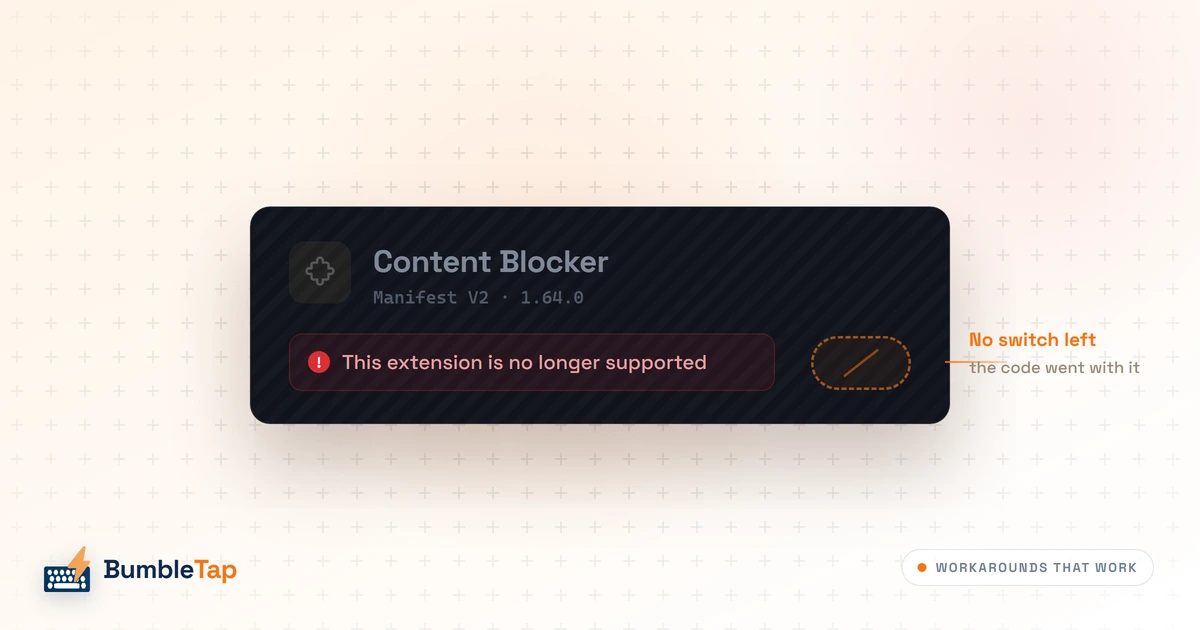
That banner is Chrome telling you it has disabled a Manifest V2 extension. It is not a warning about something you can fix, and it is not asking you to take an action — it is a notice that the decision has already been made and applied. "No longer supported" means the extension platform it was built on, Manifest V2, is one Chrome stopped running in July 2025. Nothing about the extension itself is broken, and there is no updated version of Chrome, no permission and no setting that turns it back on.
The same goes for the flag people find while searching for a way around it. chrome://flags/#allow-legacy-mv2-extensions was real and it did work, back when the toggle still existed. It doesn't now. If you land on a forum post recommending it, the post predates Chrome 138; if the flag still appears in your browser at all, setting it changes nothing. The enterprise policy ExtensionManifestV2Availability outlived it and is gone for consumers too, and Chrome 150 and 151 swept up the last of the internal flags in mid-2026. The timeline below has the version each escape hatch closed in.
So the honest answer to "how do I re-enable it" is that you cannot, and the useful question is what replaces it. That is the guide next door.
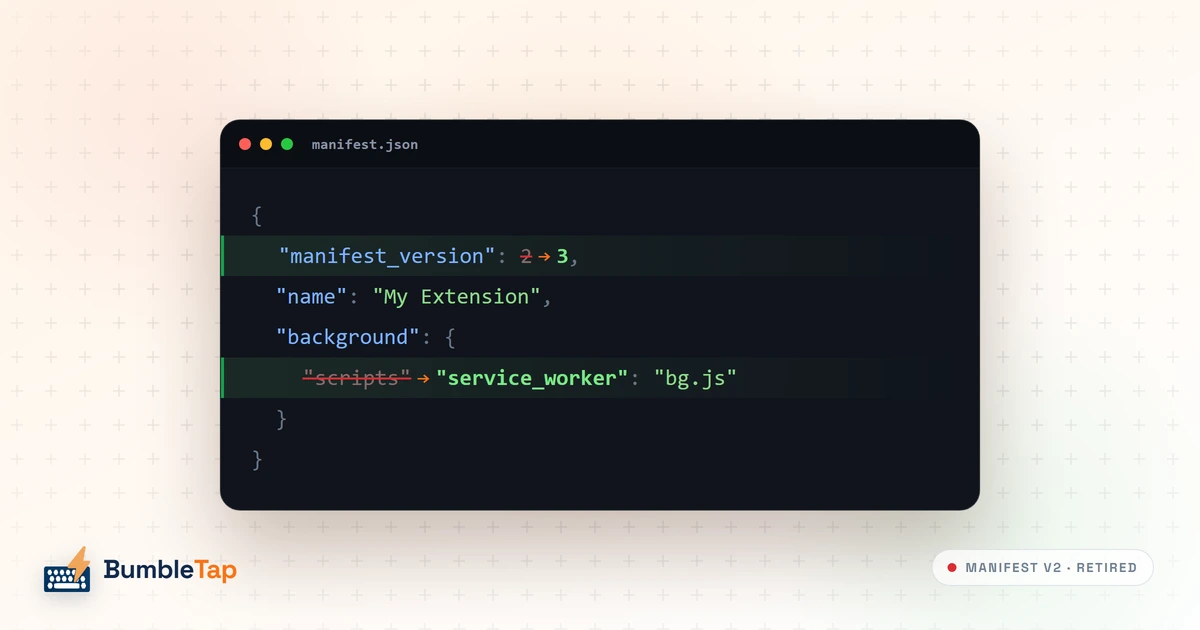
If you're the kind of person who wants to see it in the file, flip on Developer mode in the top-right of chrome://extensions, click an extension's Details, and you can inspect its folder. The manifest tells you outright:
{
  "manifest_version": 3,
  "name": "Some Extension",
  "version": "1.4.2"
}
A 3 there is the whole answer. A 2 would mean an extension Chrome is no longer willing to run. In practice you'll only ever find 2 on something already disabled.
Why Google actually forced this
Now the part that makes this a how-it-works post instead of a news blurb. Manifest V3 wasn't cosmetic. Google rebuilt three specific mechanisms, and each one traded capability for a property Google wanted. I think two of the three trades are clearly defensible and one is genuinely contested. Let me take them in order and be fair to both sides, because the internet has largely picked a team on this and stopped reading.
The code can't change after Google looks at it
Under Manifest V2, an extension could fetch code from a server at runtime and execute it. A background page could pull down a script and eval it, or inject a remote <script> tag, and suddenly be running logic that was never in the package Google reviewed:
// Manifest V2 background page — the pattern MV3 bans outright
(async () => {
  const res = await fetch("https://vendor.example.com/latest-logic.js");
  // This runs code Google's reviewers never saw. It can change any time
  // the server changes, with no new review and no user prompt.
  eval(await res.text());
})();
Manifest V3 forbids remotely-hosted code. All executable logic has to ship inside the extension package that went through review. Manifest V2 already blocked eval and remote scripts by default, but it let a developer loosen the content security policy to allow them. V3 removes that escape valve: there is no supported way to weaken the policy back into running code you fetched at runtime. Chrome's migration docs are blunt that remotely-hosted code isn't allowed: an extension can reference and use only the JavaScript files present in its own bundle.
Frame it from the user's side and this one is hard to argue with. Under MV2, the thing Google reviewed and the thing running in your browser could be two different programs. An extension could pass review as a tidy little utility, then phone home a week later and become a keylogger, and the review that was supposed to protect you covered a version that no longer existed. Banning remote code means the reviewed artifact and the running artifact are the same artifact. That's a real security win, and it's the change I'd defend without flinching.
The cost is narrow but real: legitimate patterns that shipped logic remotely — some A/B testing frameworks, remote feature flags that carried behavior rather than just data, quick hot-fixes without a store round-trip — all broke and had to be rebuilt inside the package. Annoying for developers. Good for users. I'll take the trade.
The browser blocks requests now, not the extension
This is the one people are actually angry about, and they're not wrong to be.
Manifest V2 gave extensions a blocking version of the webRequest API. It let an extension register a listener that Chrome would call for every single network request the browser made, hand it the details, and wait for the extension's own JavaScript to decide, at that moment, whether to allow it, block it, or rewrite it:
// Manifest V2 background page — blocking webRequest
chrome.webRequest.onBeforeRequest.addListener(
  (details) => {
    // Arbitrary code runs for every request and decides, live, what to do.
    if (looksLikeAnAd(details.url)) return { cancel: true };
  },
  { urls: ["<all_urls>"] },
  ["blocking"] // <-- this mode is what MV3 removed
);
That is enormous power. It's also enormous visibility: to make that decision, the extension gets to see every URL you request, in code it fully controls. That's exactly what made blocking webRequest the foundation of serious content blockers, and exactly what made Google nervous about it.
Manifest V3 replaces it with declarativeNetRequest. Instead of running your code on every request, the extension declares its rules ahead of time, and the browser's own network stack enforces them:
// rules.json — declarativeNetRequest static rules (Manifest V3)
[
  {
    "id": 1,
    "priority": 1,
    "action": { "type": "block" },
    "condition": {
      "urlFilter": "||ads.example.com^",
      "resourceTypes": ["script", "image", "xmlhttprequest"]
    }
  }
]
// manifest.json — wiring that ruleset in
{
"manifest_version": 3,
"permissions": ["declarativeNetRequest"],
"declarative_net_request": {
"rule_resources": [
{ "id": "ruleset_1", "enabled": true, "path": "rules.json" }
]
}
}The difference is the whole argument. With declarativeNetRequest, the extension never sees your traffic. It hands Chrome a rulebook, Chrome does the blocking, and the extension is out of the loop. Google's case is privacy plus performance: your ad blocker can no longer read your entire browsing history request-by-request, and there's no extension JavaScript sitting in the hot path of every network call. Both of those are true, and for the median extension they're a clean upgrade.
The cost is that declarative rules can't express everything code could. declarativeNetRequest caps how many rules you can ship: a guaranteed minimum of 30,000 static rules, up to 30,000 dynamic ones, and 5,000 session rules. Google has raised those budgets more than once as the complaints came in. The safe dynamic-rule limit jumped from 5,000 to 30,000 in Chrome 121. But the count was never the real ceiling. Declarative rules can't make decisions that depend on what a response actually contains, or chain logic the way real code can. Dynamic, situational, "look at this and then decide" blocking was the entire point of the advanced tools, and the rulebook model can't reproduce all of it. This is what kneecapped the heavy-duty content blockers, and the backlash was earned.
Here's the honest steelman for the people who are furious, because they deserve a fair hearing and not a shrug. Grant Google every word of the privacy argument. It's still true that declarativeNetRequest is strictly less expressive than blocking webRequest, and no amount of good intent closes that gap. And there's an uncomfortable optics problem sitting underneath: the company telling you your ad blocker has to get weaker, for your own privacy, is the company that sells the ads. You can believe the privacy benefit is real and believe the same benefit could have been reached with less collateral damage: a stricter permission, an audit path for trusted blockers, a narrower API instead of a blunter one. I don't think Google acted in bad faith here. I do think "trust us, it's for your privacy" is a big ask from the ad company, and the critics who wanted the win without the amputation have a point.
The background page stopped being always-on
The third change is the one developers grumbled about most and users noticed least. Manifest V2 extensions had a persistent background page: a hidden page that loaded when the extension started and stayed resident for the whole browser session, holding whatever state it liked in plain variables.
Manifest V3 replaced it with a service worker. A service worker is event-driven and ephemeral: Chrome spins it up to handle an event, lets it go idle, and terminates it after roughly 30 seconds of inactivity. Google's argument is memory and performance: an extension you're not actively using shouldn't be squatting on a live process and a chunk of RAM just in case. On a machine with forty tabs and a dozen extensions, that adds up, and event-driven workers that unload when idle are the right default.
The friction is that "your background context can be killed at any moment" forces a real rewrite. Any state you kept in a global variable evaporates when the worker unloads. Listeners have to be registered synchronously at the top level or the event that would have woken the worker gets missed. setTimeout for anything longer than the idle window is a trap, because the timer dies with the worker; you reach for chrome.alarms instead. None of it is exotic, but all of it is different, and a decade of MV2 code and tutorials assumed the opposite. I wrote a whole separate post on why MV3 service workers keep dying and how to build around them if you want the gory lifecycle details.
I ship BumbleTap on this model, so take my verdict for what it's worth: I made my peace with it. The rewrite is real work the first time through, and after that it's just how the platform is. It is what it is, and once you stop expecting a background page that never dies, the ephemeral worker mostly stays out of your way. What's telling is that after all of it, the one place this migration actually landed on me wasn't a line of my own code. It was losing the real uBlock Origin, which is the part everyone actually showed up for.
So is uBlock Origin gone?
This is the question most people are actually typing into a search box, so here's the direct answer: the uBlock Origin you're thinking of — Raymond Hill's original, the one built on blocking webRequest — no longer runs on Chrome. It went dark with every other MV2 extension in mid-2025. On Chrome, that specific thing is over.
But "gone" oversells it. Hill (who goes by gorhill) built a Manifest V3 version called uBlock Origin Lite, or uBOL. It uses declarativeNetRequest and pre-compiles filter lists into static rulesets at build time. For most people, on most sites, it blocks most ads, and it does it with a smaller footprint than the original.
It is also, by design, less capable, and gorhill has never pretended otherwise. Because uBOL leans on static rules instead of live code, it can't do the dynamic, per-site, "watch what the page does and react" filtering the full version was known for. Its cosmetic filtering (the part that hides leftover empty ad boxes and page furniture) is more limited, and it can't adapt to a new anti-adblock trick until gorhill ships a fresh ruleset through the store's review queue and you update. For a casual user, uBOL is fine. For someone who ran the full uBlock Origin because they needed the advanced knobs, "fine" is a demotion, and calling uBOL a drop-in replacement would be dishonest.
The full uBlock Origin isn't extinct, though. It just doesn't live on Chrome anymore. Firefox kept the blocking webRequest API, so the complete, unabridged uBlock Origin still runs there today. Brave took a different route entirely: its ad and tracker blocking is built natively into the browser rather than shipped as an extension, so Manifest V3's rules for extensions simply don't apply to it: requests get filtered deep in Brave's own network stack by a Rust engine, untouched by any of this. AdGuard, similarly, offers a standalone application that filters outside the extension sandbox as well as an MV3 extension.
For the record, here's where I landed, since I've spent this section describing what everyone else does. I drifted to Edge for daily browsing. It's Chromium underneath, but it hasn't pulled the plug on the full uBlock Origin the way Chrome did, so for now the unabridged thing still runs there, and I've quietly come to like Edge anyway. In Chrome I keep uBO Lite and mostly shrug; it catches what I care about. That's the real-world shape of it: the people who needed the full tool keep a second browser around for it, and everyone else takes the lite version and moves on. The catch is that "for now": Microsoft has now put an end date on MV2 in Edge too, so it's a reprieve, not a promise.
This post originally said Microsoft hadn't committed to an Edge cutoff. On August 7, 2026, after publication, it did. Microsoft announced that "beginning in August 2026, Microsoft Edge will start the consumer transition away from Manifest Version 2": notices first, then MV2 extensions turned off by default, starting on the Canary, Dev and Beta channels and broadening to Stable in the following months, with the consumer transition targeted for completion by the end of 2026. Managed devices are untouched during that rollout; enterprise deprecation follows in early 2027.
So if you moved to Edge on the strength of the paragraph above, treat it as a few more months rather than a plan. Firefox is the durable answer — Mozilla has committed to keeping both Manifest V2 and the blocking webRequest API, which is why the full uBlock Origin runs there unmodified. I've laid out every remaining option in how to keep using unsupported Chrome extensions.
Where this leaves you
For you, as someone who just wants their browser to work: basically nothing. Your extensions are V3 or they wouldn't be running. August 31 deletes some store listings you weren't visiting. The internet's countdown timers are counting down to a database DELETE.
The one genuinely practical thing to do is future-proofing, not firefighting. If there's a Manifest V2 extension still clinging on somewhere in your world (an old machine your team never updated, a locked-down work laptop, a Chromium fork with its own rules), understand that once the listing is gone, that extension can't be reinstalled or moved to a new device. So if you depend on one, go find its V3 successor now, while you can still search the store for it. After August 31, the trail goes cold.
On the other browsers: Edge, Brave, Opera, and the rest are all Chromium underneath, so they all inherit the Manifest V3 platform and will land in the same place eventually. But they set their own clocks. Brave, as above, blocks natively and mostly sidesteps the extension-API drama. Microsoft set Edge's Manifest V2 timeline independently rather than mirroring Chrome's dates, and on August 7, 2026 it published that timeline: the consumer transition starts in August 2026 on the preview channels, broadens to Stable over the following months, and targets completion by the end of 2026, with managed devices following in early 2027. Different clock, same destination. The safe rule: Chrome's August 31 date is a Chrome date. Don't assume it governs whatever else you run.
One aside, since it's fair to disclose where I'm standing. The extension I build, BumbleTap, is Manifest V3 and doesn't fetch code from a server to run: everything it executes ships inside the reviewed package. So for me this migration was the water, not a wave: it's just the shape the platform is now. I'm not neutral about MV3, but I'm also not its victim, and I've tried to keep both of those true above.
The real story here was never August 31. It's the four-year trade Google made: some concrete user power, mostly in the hands of people running serious content blockers, exchanged for a platform where a reviewed extension can't secretly rewrite itself, can't read all your traffic, and can't idle in the background eating RAM. Two of those three are wins I'd defend to anyone. The third one cost real people a real tool, and Google's cleanest privacy argument for it comes, awkwardly, from the largest ad company on earth. Hold both. The countdown timers can't.
Chrome's is not the only support cliff this year. Python 3.10, .NET 8, PostgreSQL 14 and Kubernetes 1.34 all lose support inside the next quarter, and the same pattern applies to every one of them: nothing breaks on the day, and then the ecosystem starts refusing you. We keep a running end-of-life calendar of what loses support next, with a note on what actually breaks in each case.
Caveats
- Every date and version above is Chrome's published deprecation timeline as of mid-2026. Version numbers and cutoffs have moved more than once across this rollout; if you're reading this much later, check the current Manifest V2 deprecation timeline rather than trusting a snapshot.
- Edge, Brave, Opera, and other Chromium browsers inherit Manifest V3 but run their own schedules. Nothing here about Chrome's dates should be read as a promise about a non-Google browser. Confirm against that browser's own announcements.
declarativeNetRequest's rule limits are specific numbers, and Chrome has raised them more than once: the safe dynamic-rule budget jumped from 5,000 to 30,000 in Chrome 121. The figures above are current as of mid-2026; check the API reference before you design around a cap.- uBlock Origin Lite is under active development, and its capability gap versus the original narrows as gorhill and the DNR API both improve. Treat any "uBOL can't do X" claim, including mine, as a thing to re-test rather than a fixed law.
- This describes Chrome's extension platform. Chrome on iOS runs WebKit and a different extension story entirely, and Chrome on Android doesn't run this class of extension at all.
Frequently asked questions
- Will my Chrome extensions stop working on August 31, 2026?
- No. Any extension that runs in Chrome today is already Manifest V3, because Manifest V2 extensions stopped executing on stable Chrome back in Chrome 138 in July 2025. The August 31, 2026 date only removes leftover Manifest V2 listings from the Chrome Web Store. It deletes the store pages, not anything running in your browser. Extensions you already have installed keep working exactly as they do now.
- What does "These extensions were turned off because they're no longer supported" mean?
- It means Chrome has disabled a Manifest V2 extension. Manifest V2 is the extension platform Chrome stopped running in July 2025, so "no longer supported" refers to the platform, not to a fault in the extension. It is a notice, not a warning you can act on: there is no setting, permission, flag or Chrome version that turns the extension back on.
- How do I re-enable an unsupported Chrome extension?
- You cannot. Chrome 138 removed the manual re-enable toggle for every user on every channel in July 2025, and Chrome 150 and 151 removed the last remaining feature flags in mid-2026. The enterprise policy that outlasted both is gone for consumers too. There is no setting, flag or Chrome version left that turns a Manifest V2 extension back on — what you can do is replace it, and every route that still works in 2026 is in the companion guide.
- Can I re-enable an unsupported Chrome extension?
- No — the last mechanism was removed in Chrome 151. What replaces it is a separate question, answered in you can't re-enable an unsupported Chrome extension.
- How do I know if an extension is Manifest V2 or V3?
- The quickest test is that it works. Manifest V2 extensions haven't run on stable Chrome since Chrome 138 in July 2025, so anything currently doing its job is Manifest V3 by definition. To check directly, open
chrome://extensions. Any extension Chrome has greyed out with a "no longer supported" note is a Manifest V2 leftover, and everything else enabled and functioning is V3. Developers can confirm by reading themanifest_versionkey in the extension'smanifest.json. - Is uBlock Origin gone from Chrome?
- The original uBlock Origin (a Manifest V2 extension) no longer runs on Chrome, along with every other MV2 extension. Its author, Raymond Hill, built uBlock Origin Lite (uBOL), a Manifest V3 version that uses the declarativeNetRequest API. uBOL blocks most ads from static rule lists but is genuinely less capable than the original, because MV3 removed the dynamic request-filtering the full version relied on. The complete uBlock Origin still works in Firefox, which kept the blocking webRequest API that Chrome removed.
- Why did Google remove Manifest V2?
- Google's Manifest V3 required three technical changes it argued were about security, privacy, and performance. Extensions can no longer run code fetched from a server after install, so a reviewed extension can't quietly become something else. The blocking webRequest API, which let an extension inspect and modify every network request in its own code, was replaced by declarativeNetRequest, where the browser enforces rules the extension declares up front. And the always-running background page became an event-driven service worker that shuts down when idle. The security and privacy arguments are reasonable; the cost landed hardest on advanced content blockers.
- Does this affect Microsoft Edge or Brave?
- Both Edge and Brave are built on Chromium, so they inherit the Manifest V3 platform, but each browser sets its own deprecation schedule rather than following Chrome's dates exactly. Brave's ad and tracker blocking is built natively into the browser rather than shipped as an extension, so Manifest V3's restrictions on extensions don't apply to it. Microsoft set Edge's Manifest V2 timeline independently of Chrome's, and announced it on August 7, 2026: Edge begins turning MV2 off that month on the Canary, Dev and Beta channels, broadening to Stable over the following months, with consumers targeted for the end of 2026 and managed devices following in early 2027. So don't assume Chrome's August 31 date applies there. Check your specific browser's own announcements.
- Do I need to do anything before August 31, 2026?
- Almost certainly nothing. If your extensions currently work, they're already Manifest V3 and the August 31 Web Store cleanup doesn't affect them. The one case that needs attention: if you rely on a specific Manifest V2 extension that's still installed on an old Chrome build, know that it can't survive a reinstall, a new profile, or a new machine once the listing is gone, so find its Manifest V3 successor now, while you can still search for it.
- What is the difference between Manifest V2 and V3?
- Manifest V2 and Manifest V3 are the two platform generations for Chrome extensions, marked by the
manifest_versionkey in an extension'smanifest.json. V2 launched in 2012 and ran extensions for over a decade; V3 reached stable Chrome in January 2021 and is now the only version that runs. V3's headline changes: it bans remotely-hosted code, replaces the blocking webRequest API with declarativeNetRequest, and swaps the persistent background page for an ephemeral service worker.