QR Code Generator
Turn a link, a Wi-Fi network, an email or a text message into a QR code — then take the PNG or SVG with you. No account, no watermark, and no redirect in the middle that can expire or start charging you later. Or skip the form entirely: Create QR Code for Any Page puts it on a single key, on every site you visit.
- Version
- 2
- Modules
- 25×25
- Data
- 21 B
Generated entirely in your browser — logo included. Nothing you type or upload is sent anywhere, and the codes never expire, because there's no redirect in the middle.
Generate a QR code on any webpage with one keypress
Create QR Code for Any Page — the blueprint that lives on your keyboardIf you share links from your laptop often, coming back to this page each time is three steps too many. Add the blueprint and it happens in place: press Q on any site and a code for that page appears over it — or highlight something first and it encodes your selection instead.
What you can put in a QR code
A QR code is just a container for a short string of text. What makes one scan into a Wi-Fi prompt and another into a browser is a prefix that phone cameras recognise —WIFI:, mailto:, SMSTO:, tel:. The tabs above write those prefixes for you, with the escaping the formats require, which is where hand-rolled codes usually go wrong: an unescaped semicolon in a Wi-Fi password silently truncates the rest of the payload. The formats come from ZXing's Barcode Contents — the de facto reference every phone camera ended up implementing, which specifies escaping \, ;, ,, : and " with a backslash.
Making one that actually scans
Most QR failures are physical, not digital. Four things account for nearly all of them:
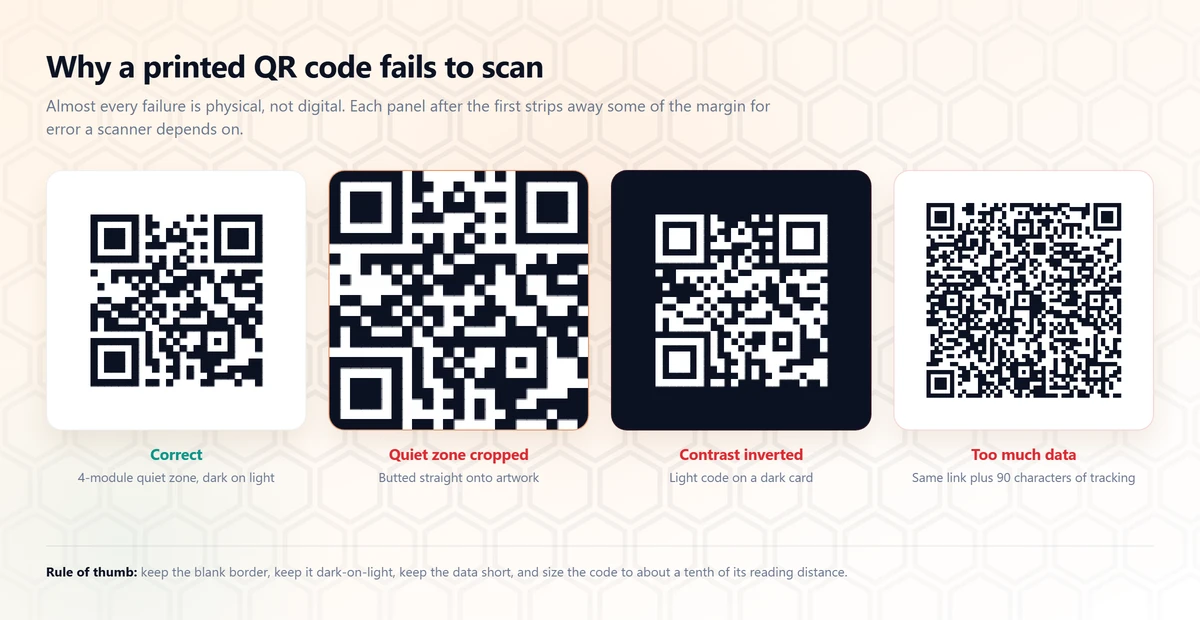
- Keep the quiet zone. The blank border around the pattern is part of the code, not padding — ISO/IEC 18004 specifies four modules of it. Cropping tight to the edge is the single most common reason a printed code will not read. Every download from this page includes it.
- Keep the contrast dark-on-light. Scanners expect dark modules on a light background. Inverting it — light code on a dark card — fails on a surprising number of phones. If you want a dark design, put a light panel behind the code.
- Shorter data means a sparser code. Every extra character pushes the version up and the modules smaller. A link with 40 characters of tracking parameters is meaningfully harder to scan than the same link without them.
- Size it for the reading distance. Roughly a tenth of the distance it will be scanned from. Test the actual printed piece, not the screen.
Static codes, and why that matters
Codes made here are static: your URL is encoded into the pattern itself. Many free generators produce dynamiccodes instead, which encode a link to the provider's own domain and redirect from there. Dynamic codes are genuinely useful when you need to change the destination after printing or track scans — but the tradeoff is that a company you do not control now sits between your code and your visitors, and can meter, rebrand, or retire it. For a poster, a business card, or a guest Wi-Fi sticker, static is the safer default.
Questions
Do these QR codes expire?
No. The code encodes your link directly, so there is no redirect service in the middle that could shut down, rate-limit, or start charging. Once the image exists it works as long as the destination does — a printed code from this page will still scan in ten years.
Is a QR code generator free?
This one is, with no account and no watermark. Be careful with tools that offer a 'free dynamic QR code': dynamic codes point at the provider's redirect URL rather than yours, which means the provider can disable the code, put an ad in front of it, or move it behind a subscription later.
How do I make a Wi-Fi QR code?
Pick the Wi-Fi tab, enter the network name exactly as it appears in the list of networks, choose WPA (which covers WPA2 and WPA3), and type the password. Scanning it with an iPhone or Android camera offers to join the network directly. Note that the password is stored in the image as plain text, so anyone who can scan the printed code can read it.
PNG or SVG — which should I download?
SVG for anything that gets printed or resized: posters, packaging, business cards, laser engraving. It is vector, so it stays perfectly sharp at any size. PNG for screens, slide decks, and anywhere that will not accept a vector file.
What does the error correction setting do?
It controls how much of the code can be dirty, scratched, or covered and still scan — 7% at Low up to 30% at High. Higher correction means more modules, so the pattern gets denser at the same physical size. Medium is the sensible default; use High only for codes that will be printed on something that gets handled, or if you plan to place a logo over the middle.
How small can I print a QR code?
The usual rule of thumb is that the code should be at least one tenth of the scanning distance — about 2cm across for a code read at arm's length, and much larger for a poster read from across a room. Always leave the white quiet zone around the edge; cropping it tight to the pattern is the most common reason a printed code fails to scan.
Does anything I type get uploaded?
No. The page loads a JavaScript QR library and does all the work in your browser, so URLs, Wi-Fi passwords, and messages never reach a server. You can confirm it by opening your browser's network tab while generating a code, or by turning off your connection — the tool keeps working offline.